
I am heartbroken…. I have called Minnesota “home” my entire life. And there is something remarkably strange about knowing your life is occurring in a place and time that will one day be depicted within history books. Some days I wake up to a silence that holds all the promise and possibility of normalcy, and my nervous system welcomes its charade. But I know if I turn on any device, I will be accosted by yet another reminder of how aberrant human behavior can become.

Lately when I leave my home, I find myself wondering about the most unnatural thing… what hostility might I encounter between perfect strangers? And even more pressing, I wonder which version of myself will be present with them, FEAR or LOVE. As if on a fact-finding mission, I am bringing hypervigilance with me as I move through my activities. Curious, I am looking closer, feeling deeper, listening more intently, looking for signs that might confirm or dispute the feeling that we are being collectively terrorized.
What I have noticed is that I am still joined by many people shopping for groceries, wandering the malls and picking up prescriptions. And, if I am being honest, they appear quite unaffected. I have also noticed more doors being opened for strangers, more eyes meeting, more time listening and a sincerer interest in the inquiry, “How are you today?” Underlying it all, there is another observation. With uncanny regularity, I find many hands are trembling. Whether it is the young barista entering my order, or the friend lifting a cup of coffee to her lips, our bodies are telling the truth. We are living in a time and place that is charged with so much fear the air crackles with dysregulation. It makes thinking, full exhalations and just being present incredibly difficult.
My go-to-coping strategy is dissociation. I have a keen ability to just pop out of my sense experience and “watch” from a “safe” distance. But I am feeling called to bring some latent part of me, that I cannot quite name yet, forward. Stirring within me is a strange tenacity with an impassioned argument that everything I have experienced thus far has prepared me for “these times.”

Often, I resist its call for action, justifying my timidity with “proof” that most people find my worldview quite childlike. Just to clarify how I orient myself in the world, here is a concise set of my most strongly held beliefs. I believe our nature is inherently good. I see and feel wonders of nature all around me. And while my life has had its struggles, I do not believe that life is difficult as much as it is instructive. My viewpoint is so readily assessed and dismissed by others that I rarely get to finish a sentence. The regularity in which I am interrupted or talked over is as certain as my shadow on sunny days. And yet there is a fierceness bubbling inside right now that is insisting I speak and share my perspective.
I am trembling as I attempt to meet its challenge.
We are suffocating in visuals and messages of fear. Each delivering their own version of a singular message, “the enemy is among us.” And perhaps less willingly stated, none of us feel equipped to respond. Our world situation is so complex and multifaceted that often when I attempt to consider a response, it feels like trying to stop a runaway freight train with a butterfly net. When I feel scared and do not know how to effect positive change, I easily start spinning my wheels at the intersection of despair and powerlessness.
But what compounds my disempowered feeling is the reductive and binary message, “if you are not in an angry act of resistance, you are complicit.” This kind of judgement feels personal to me because I will never be that person. That is not my way. I also believe it creates even more distance between us and worse yet, silences voices that could offer even the slightest shift in perspective that moves us one degree closer to each other.
So, my current “act of resistance” is to share with you how I choose to be with “what is.”
There are a lot of life skills I learned while working as a picture framer. Several feel quite alive for me right now. The most obvious one is that there is NOT only one way to see something. For over a quarter of a century, I practiced the art of seeing something in endlessly diverse ways and I bring that skill with me and use it with every person, place, and thing I encounter. Each time I remain open to different perspectives, explanations or experiences, my view grows and deepens. And something even more important happens, I become calmer and wiser in my response.
There are two other skills that evolved as I responded to common client requests. Often when someone decided to frame an important object, something quite unconscious but predictable happened. They wanted it to appear “better” than it was. But not in the obvious way. Custom framing is not an inexpensive proposition, and it is completely understandable that when you decide to invest in it you would want your artwork or heirloom to “look its best.” Furthermore, hanging something on our wall places it in a more public light and there is an equally natural interest in moving it towards its most optimal presentation.
But there was something else happening. With conspiratorial whispers, our clients would make impassioned pleas that we alter their artwork into a condition that was different than it arrived. For example, their treasured gig poster had wrinkles in it after moshing at a “life changing” concert…and they would want me to “iron out” the wrinkles. A roof leak at the cabin that had been in the family for over a century caused water stains on their great grandfather’s lake map….and they wanted me to “bleach out” the water stains. Or a well-loved artwork they had created in the second grade had torn pin holes and a missing corner because their mom insisted on thumbtacking it onto her bathroom wall….and they wished I could “mend or replace the missing paper.”
What became clear to me is that sometimes, what people want to present is not always the most accurate version of what is. Each of these projects came in with amazing stories of how the condition came to be and yet, rather than appreciating and finding beauty in its real and current condition, what they preferred and often cajoled to have hanging on their wall was something less reflective (or less true) of its past.
My advice had a familiar refrain. Rather than trying to conceal its condition, I think we should use it to guide our design process. Life is messy and it creates conditions that aren’t “picture perfect.” But what lies before us is real. It’s telling its story.
To be honest, this wasn’t always my first instinct. In my earlier years as a picture framer, I would join them in their desire to conceal or “beautify” the parts that were imperfect. But often in our efforts to conceal, we would lose something even more precious and it didn’t take long to realize, not only were the results disappointing, but also the process was tremendously stressful.

Let’s take the example of the child’s art with the torn upper right corner. When we looked at covering the missing paper, we realized we would also lose a sizable portion of the smiling sun at the top and entirely conceal a tiny but adorable cat drawn at the lower right corner. Option B had us color matching and attaching paper to the missing corner. But it also required us to mix new crayon colors with old, faded ones, and attempt to render the parts that were missing. It may have passed from a normal viewing distance, but any closer look would have revealed our attempts to “fool the eye” and cheapen its charm. Finally, if we just allowed the torn corners and pin holes to show, the client would have an opportunity to share about the affection her mother had for the piece and her frugal but steadfast efforts to keep it up on her wall. This was the option our client chose, and she later told us her ability to share that part of the story fostered greater appreciation for both her mom and the piece.
After several of these experiences, I became much quicker to accept the condition in which the item arrived and help the client do so as well. When our focus shifted, the creative process came alive and we were able to find more ways to bring the best forward. And frankly, I felt far more responsive and effective.
There is another awareness I gained from this career path. How we present something either supports or distorts the viewing experience. Allow me to illustrate the point with another real-life example.

Our client arrived with a beautiful and expansive landscape replete with stunning cloud formations and a primitive dusty road that moved from the foreground to the background. In the lower left corner was a singular red poppy that stood in stark contrast to the rest of the image. The client told me a remarkable story of how she came to find the artwork and how she decided to buy it, despite its expense. Explaining that her mother recently passed away and the poppy was her favorite flower. The client had an obvious emotional connection to the poppy and wanted it to be the focal point. She insisted on using a red mat or frame.
I started by showing her what she requested, but I also brought my expertise to the table and explained the function of framing. “Framing defines the edges, and it should move our attention both towards the art and within it.” Affirming her choice, I said, “The red is going to be an effective ‘shout across the room,’ but are you feeling like your eye can easily meander through the entire image? Or is your eye doing something else?
At this point, the client admits it feels hard to get beyond the red. She said, “It is like a stop sign to my eye.” Confirming what she was feeling, I shared how framing can either be a gentle guide or a force to overcome in the viewing experience. She went on to say, “It’s strange, because I am seeing the poppy, which is what I wanted, but it is the only thing I am seeing.” I took the opportunity to explain what I came to call the “hopscotch effect.” When the frame is either in conflict with the balance of the visual field or attempting to be too directive, what often happens is our eye attempts to reconcile why it is there. And it does this by skipping across whole sections of the image in order to connect with the part that supports its presence. In this more “forced viewing” we are feeling conflict, limits to and sometimes even a complete hinderance to seeing the entire work of art.
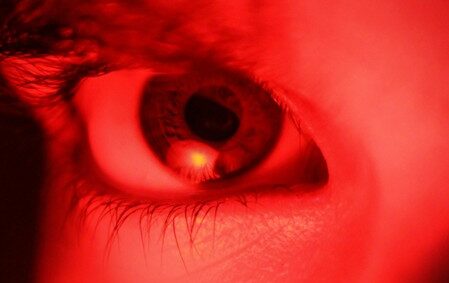
I don’t know about you, but lately I have been “seeing red” and because of my experience, I recognize when a presentation is forcing or obscuring a full appreciation of what is present.
I know there is no comparison…I will say it, so you don’t have to. But I must tell you these skills and awarenesses, honed while working as a humble picture framer, have been priceless as we collectively look on at a world that is ugly…and, unfortunately, all too real. I am not trying to conceal it, nor am I necessarily fighting against it. Instead, just as I faithfully learned as a picture framer, I am trying to uncover, support, and appreciate the full view of events so I can bring a margin of beauty (humanity) forward.

How do I do this? I start with my one indisputable truth, which sits at the center of my core beliefs. Every person we see embroiled in conflict on our TV screens has a history and a story and…. immutable humanity. EVERY ONE of them, without exception.
Personally, I find it easy to recognize and empathize with the humanity of a man who is handcuffed and escorted by a pair of masked and armed law enforcement agents into the cold of a Minnesota winter day, wearing only a pair of shorts, crocs and a blanket slung over his bare back.
What is far less easy for me, is to find the humanity of the ICE agent who is manhandling a disabled woman or shooting a man in the back who has already been wrestled to the ground. So, what do I do with that? Lately, it begins with yet another painful acknowledgement of what is in front of me and an indignant question like, “How did we get here?” Or “who DOES that?” If I end there, I have ended with judgement and usually despair. And the initial unsettling footage becomes even more so because I have lost sight of the humanity present in everyone involved. So, I go a step further…wearily and begrudgingly.
I look at the brief camera footage and remind myself, this, too, is a form of “framing.” It is a moment in time that has been bracketed and presented for public viewing. When I find myself “only seeing red,” I slow myself down and note what I can objectively see. I notice when I am skipping over details and focusing only on the parts the presentation has directed me towards. And I ask myself is the “framing” allowing me to discover and see the entire story? And what might be concealed in this presentation?
The “ugly conditions” I see are real, but they conflict with my belief that we are all inherently good and I am desperate to find understanding. I am lucky that my experience has taught me how I feel when a presentation limits my ability to see all that is present. But lately, because I am so distressed, I am blindly accepting the commentary being offered with the footage. I suspect we are all doing this. Our minds are “meaning making machines and when things don’t make sense, we are quick to accept someone else’s explanation, forgetting it may not be a full and accurate picture. Without access to a complete view of things, we are left filling in the gaps with misguided judgement and our own unchecked fiction.

We are living in a time where there is a lot to be gained by “framing” things in limiting ways. “These are vicious criminals among us, who are here illegally, and we are trying to make our country safe.” OR “These are men emboldened by our current administration to act on the hate in their hearts.” Either way, I look at the two narrow presentations consistently being offered and my body tells me it is not the entire story. Is it possible? Sure. But people and life are far more complicated than these oversimplified sound bites. So, I ask myself what else could be true? What might I not be seeing? And what might be MORE true if I were looking for their humanity?
When I was called to launch YOU.logy and share the challenge of getting to know and interact with people in a unique way, I felt a deep visceral fear. I did not understand why…now I do. Times like this make it hard to believe in the benevolent nature of humankind. And although I often feel quite alone in my belief, I am comforted by Byron Katie’s quote, “No one would harm another human being unless they were confused and suffering from distorted thinking.” And while I know this is not a popular perspective, and certainly not one I arrived at easily, I do believe there are human hearts among us that will be tormented by their own acknowledgment that their unchecked reactivity either directly or indirectly contributed to the harming or ending of human life. I would not want that to be any part of my personal legacy, and I continue to believe there is not a human heart among us that would.

Is it possible we are accepting a dangerous and extremely limiting view of each other? Is it possible, our best form of resistance to all this madness is to go into the world with genuine interest to know each other? To meet each other with open, mindful presence, thoughtful inquiry, active listening, and a desire to understand and find good in each other? WHEN we choose to do this, we can gain greater knowledge and foster appreciation for who someone is and why. And if we accept the challenge of expressing the goodness we encountered within them, we create an opportunity for them to live from and bring a greater version of themselves into the world.
This is not for everybody, nor would I presume my way ought to be your way. But my act of resistance is to truly see people and the circumstances they have lived through. By making a commitment to finding the good, and letting them know what I experienced with them, I may be able to remind them of their own hidden, lost, or forgotten goodness and inspire them to bring more of it forward.
Does YOU.logy feel like the version of resistance you can get behind? Please share your thoughts and reactions.
3 responses to “Seeing Red”
Thank you for your meticulously crafted, hopeful perspective! All the goings on of late have made me feel naive in my belief that humankind, by and large, is benevolent. Of course, I was perhaps afforded that privilege before the unspeakable horrors that have always befallen our fellow humans began happening on this side of the pond. I look forward to the day when your perspective prevails, my friend!
Thanks for such a warm reception, Clelia. I will go to my grave trying…
Thanks for sharing this. I hope you are well.